A Caribbean yacht charter costs $5,000-$15,000 per week for a bareboat catamaran in the British Virgin Islands, $12,000-$28,000 per week for a crewed catamaran for 8 guests, and $25,000-$80,000+ per week for a crewed motor yacht. The five primary charter destinations are the British Virgin Islands, St. Martin and Sint Maarten, the Grenadines, Antigua and Barbuda, and Martinique and Guadeloupe. December through April delivers the most reliable trade winds and the lowest storm risk. Hurricane season risk is real but concentrated in August-October, not the entire June-November window that most guides cite. All pricing verified March 2026 across 150+ Caribbean charter listings.
The Caribbean accounts for roughly 25% of the global yacht charter market and represents the world’s most developed island-hopping infrastructure. From the BVI’s legendary bareboat routes to the Grenadines’ remote anchorages and Martinique’s French-Caribbean culture, the region spans an extraordinary range of sailing environments within a single ocean basin. Yet the charter process generates predictable first-timer confusion: APA and crew tips add 40-55% to the base fee, hurricane season risk is more nuanced than widely reported, and the catamaran-vs-monohull decision shapes the entire experience. This guide breaks down every major Caribbean charter destination, compares real costs, and identifies the mistakes that cost first-time charterers thousands.
Charter Costs by Island Group
The price on a charter listing represents 50-60% of what you will actually spend. Understanding the full cost structure across the Caribbean’s main island groups is essential before signing a contract.
Base Charter Fees
| Destination | Bareboat Cat (40-50ft) | Crewed Cat (50-60ft) | Crewed Motor (65-80ft) | Superyacht (90ft+) |
|---|---|---|---|---|
| British Virgin Islands | $5,000-$15,000/wk | $12,000-$28,000/wk | $25,000-$70,000/wk | $80,000-$200,000/wk |
| St. Martin / Sint Maarten | $7,000-$16,000/wk | $14,000-$30,000/wk | $28,000-$75,000/wk | $85,000-$220,000/wk |
| The Grenadines | $6,000-$18,000/wk | $14,000-$32,000/wk | $30,000-$80,000/wk | $90,000-$250,000/wk |
| Antigua and Barbuda | $6,000-$14,000/wk | $12,000-$26,000/wk | $25,000-$65,000/wk | $75,000-$180,000/wk |
| Martinique and Guadeloupe | $5,000-$12,000/wk | $10,000-$24,000/wk | $22,000-$60,000/wk | $70,000-$160,000/wk |
The Real Cost: What Gets Added
The base charter fee covers the boat and, on crewed charters, the crew’s salary. Everything else comes on top.
APA (Advance Provisioning Allowance): 30-40% of base fee. This upfront deposit covers fuel, food, drinks, marina and mooring fees, and consumables. On a $20,000 crewed catamaran charter, budget $6,000-$8,000 in APA. Motor yachts doing longer inter-island passages (BVI to Anguilla, Grenadines leg from St. Vincent to Grenada) burn significantly more fuel than sailing yachts, pushing APA toward 40%. Unused APA is refunded at charter end, typically 10-20% returns.
Crew gratuity: $150-$200 per day for a full crew. On a 7-night charter with a captain, chef, and one deckhand, budget $1,050-$1,400 in tips for the crew. This is customary and expected, not optional. A crew of four on a larger motor yacht scales up proportionally.
Mooring and marina fees: $30-$300 per night. The Caribbean has more paid mooring balls than the Mediterranean’s free-anchoring norm. The BVI’s National Parks Trust charges $30/night per ball at popular anchorages (Norman Island Bight, Pelican Island, the Indians). Marina berths in Gustavia (St. Barths), Falmouth Harbour (Antigua), or Rodney Bay (St. Lucia) range from $100-$300 per night depending on yacht size and season.
The costliest mistake: Budgeting only the base fee. A $15,000 base charter for a crewed catamaran becomes $24,000-$27,000 all-in after APA ($5,500), crew tips ($1,200), mooring fees ($700), and provisioning extras. Always multiply the quoted fee by 1.6-1.7 for a realistic Caribbean charter budget.
Per-Person Economics
Split across a group, Caribbean charters compare favorably to luxury resort stays, especially when the crew handles all cooking, cleaning, and water sports.
| Scenario | Base Fee | All-In Cost | Per Person (8 guests) | Equivalent Resort |
|---|---|---|---|---|
| Bareboat cat, BVI, 7 nights | $8,000 | $12,000 | $1,500 | Mid-range resort |
| Crewed cat, Martinique, 7 nights | $18,000 | $29,000 | $3,600 | 4-star all-inclusive |
| Crewed motor, St. Martin, 7 nights | $40,000 | $65,000 | $8,100 | 5-star luxury resort |
| Superyacht, Grenadines, 7 nights | $120,000 | $190,000 | $23,750 | Ultra-luxury villa + staff |
The 5 Best Charter Destinations
Each Caribbean charter region serves a fundamentally different traveler profile. Choosing the right destination matters more than choosing the right yacht.
1. British Virgin Islands
$5,000-$200,000/week · Season: Nov-Jun · Best for: First-timers, bareboat, island-hopping · Wind: NE trade winds 15-20 knots (Dec-Apr)
The British Virgin Islands are the world’s most developed bareboat sailing ground. The geography is perfectly engineered for novice charterers: islands are spaced 30 minutes to 2 hours apart, the Sir Francis Drake Channel provides a sheltered highway between Tortola and Virgin Gorda, and navigation is straightforward. The BVI’s 60+ islands pack extraordinary variety into a compact area - from the famous Baths of Virgin Gorda (granite boulder formations with natural pools) to the Soggy Dollar Bar at Jost Van Dyke (the original painkillers) and the Caves at Norman Island.
The bareboat infrastructure in the BVI is unmatched in the Caribbean. Tortola’s Road Town and Nanny Cay host the region’s largest charter fleets, with hundreds of catamarans and monohulls from operators including The Moorings and Sunsail. This density of supply drives competitive pricing and keeps quality standards high. For crewed charters, the BVI’s concentration of anchorages with shore restaurants means guests eat ashore as often as onboard, reducing provisioning costs.
The honest downside: The BVI’s popularity is its primary limitation. In peak season (January-March), popular anchorages like the Bight at Norman Island and Cane Garden Bay fill by early afternoon. The National Parks Trust mooring balls at the region’s best spots ($30/night) are often all taken by noon. New Year’s week is particularly crowded, with Christmas-New Year charters commanding a 25-40% premium and booking out 10-12 months ahead.
Good to know: Pair a BVI charter with a day trip to the US Virgin Islands (St. John and St. Thomas are 20-30 minutes away) for duty-free shopping and access to the Cruz Bay scene. Customs formalities between BVI and USVI are required but straightforward for charter guests.
2. St. Martin and Sint Maarten
$7,000-$220,000/week · Season: Nov-Jun · Best for: Hub charters, provisioning, access to St. Barths · Wind: NE 15-25 knots, strongest Jan-Feb
St. Martin (French north) and Sint Maarten (Dutch south) form the Caribbean’s most strategic charter hub. Simpson Bay Lagoon, the largest protected lagoon in the Caribbean, houses hundreds of charter yachts year-round and offers the region’s best provisioning. The dual-nationality island gives charterers immediate access to two distinct cultures within walking distance: duty-free Dutch shopping in Philipsburg and Michelin-quality French dining in Grand Case.
St. Martin’s central location makes it an ideal base for multi-island charters. St. Barths is 20 miles east (a 2-3 hour sail or 45-minute motor), Anguilla is 8 miles north (30 minutes under sail), and Saba is 28 miles south. A typical 7-night itinerary from St. Martin covers Anguilla’s Road Bay for lunch, overnight in St. Barths’ Gustavia harbor, Ile Fourche for snorkeling, and back through St. Martin’s Orient Bay.
The honest downside: St. Martin’s Simpson Bay Lagoon requires passing under the Dutch Drawbridge connecting the lagoon to the sea. The bridge opens on a fixed schedule (twice daily), and timing constraints can add 2-3 hours to departure plans. Mast height is limited to approximately 66 feet, ruling out many larger sailing yachts. Gustavia harbor in St. Barths charges among the highest marina fees in the Caribbean ($200-$500 per night depending on yacht length), and anchoring off Gustavia is prohibited.
What to consider: St. Barths’ appeal is undeniable but the economics are steep. A single dinner for 8 at a top Gustavia restaurant runs $800-$1,200. Budget time in Anguilla’s beachside shacks at Sandy Ground instead for a fraction of the cost and a more authentic Caribbean experience.
3. The Grenadines
$6,000-$250,000/week · Season: Dec-Jun · Best for: Remote anchorages, experienced sailors, exclusivity · Wind: NE 15-22 knots (consistent Dec-May)
The Grenadines stretch 65 miles between St. Vincent in the north and Grenada in the south, forming the Caribbean’s most exclusive island-hopping route. Tobago Cays Marine Park, a protected lagoon surrounded by five uninhabited islands and healthy coral reefs, is widely considered the Caribbean’s best anchorage. Mustique, the private island owned by a consortium of celebrities and royalty, is accessible by charter yacht and offers a beach bar (Basil’s Bar) that has hosted everyone from Mick Jagger to Princess Margaret. Palm Island is a private resort island; Bequia is an authentic fishing village with a renowned whaling history.
Unlike the BVI’s busy highways, the Grenadines reward charterers who seek solitude. Anchorages are less crowded (Tobago Cays aside), wildlife includes sea turtles and spotted eagle rays, and the local culture is distinctly Caribbean rather than tourist-oriented. Grenada’s Spice Island reputation adds culinary depth: fresh nutmeg, cinnamon, and cocoa are available at the market in St. George’s.
The honest downside: The Grenadines require more sailing experience than the BVI. Passages between islands involve open-water crossings with stronger swells and currents, particularly north of Bequia and south of Carriacou. The Bequia Channel and the waters around Petit St. Vincent involve 2-4 hour open passages that can be uncomfortable in 20+ knot trade winds. Provisioning outside St. Vincent and Grenada is limited; most crewed charters provision fully before departing. Medical facilities in the smaller Grenadine islands are basic.
Good to know: A one-way charter from St. Vincent (north) to Grenada (south) with the trade winds is a consistently smoother experience than sailing north against the wind. Most charter operators offer one-way options with a repositioning fee, typically $800-$2,000 depending on the operator.
4. Antigua and Barbuda
$6,000-$180,000/week · Season: Nov-Jun · Best for: Sailing culture, regattas, world-class marinas · Wind: NE 15-20 knots, reliable year-round
Antigua is the sailing capital of the Eastern Caribbean. Falmouth Harbour and English Harbour, home to the historic Nelson’s Dockyard (a UNESCO World Heritage Site), form the Caribbean’s most sophisticated yachting hub. Antigua Sailing Week (late April to early May) is the Caribbean’s largest offshore regatta, drawing 200+ yachts and transforming the island into the region’s most intense sailing social scene. Outside regatta season, the island’s 365 beaches and the near-constant trade winds provide ideal cruising conditions.
The Antigua-Barbuda combination delivers variety within a 30-mile radius. Antigua itself offers the sailing infrastructure and nightlife; Barbuda, 28 miles north, is a nearly flat island with a 17-mile pink-sand beach and almost no tourism infrastructure. The frigate bird sanctuary at Codrington Lagoon is home to one of the Western Hemisphere’s largest frigate bird colonies.
The honest downside: Falmouth Harbour marina fees are among the highest in the Eastern Caribbean, particularly during Sailing Week when all berths are pre-booked 6-12 months ahead and priced at a premium. Access to Barbuda requires its own clearance customs formality (a short process but an additional administrative step). The island suffered catastrophic damage from Hurricane Irma in 2017 and rebuilding, while largely complete for marine infrastructure, is ongoing in some areas of the island.
What to consider: Antigua’s trade winds average 15-20 knots from the northeast throughout the season, making it one of the Caribbean’s most consistent sailing environments. First-time charterers who want reliable wind, structured harbor facilities, and evening dining options ashore will find Antigua a more comfortable introduction than the Grenadines.
5. Martinique and Guadeloupe
$5,000-$160,000/week · Season: Nov-Jun · Best for: Value, French cuisine, les Saintes · Wind: NE 12-18 knots, calmer than northern islands
Martinique and Guadeloupe are French overseas territories, meaning EU standards apply to everything from marina facilities and food provisioning to customs and currency. For charterers who value French cuisine, fresh baguettes at each anchorage, and the ability to provision in a genuine French supermarket, the French Antilles offer a quality-per-dollar ratio that is unmatched in the Caribbean.
Les Saintes (Iles des Saintes), eight miles south of Guadeloupe’s Basse-Terre coast, is frequently cited as the Caribbean’s most beautiful anchorage: a cluster of small volcanic islands with a perfectly protected bay, a morning market, and restaurants serving creole-French fusion at prices dramatically below St. Barths. The offshore island of Marie-Galante adds a sugar-cane agricultural tradition and some of the region’s best rum distilleries. Martinique’s Fort-de-France bay, Diamond Rock (a former British man-of-war battlestation), and the beaches of Sainte-Anne complete a route that rarely features in English-language charter guides.
The honest downside: French Antilles charters require navigating French bureaucratic customs procedures more formally than anglophone islands. Non-French speakers may find harbor officials and provisioning staff less accommodating than in the BVI or Antigua. Some of the better anchorages in Martinique’s south and Guadeloupe’s protected bays have limited mooring infrastructure, requiring competent anchoring skills. The 60-mile passage between Martinique and Guadeloupe involves open Atlantic exposure that can be rough in 20+ knot conditions.
Good to know: Martinique and Guadeloupe are among the best-value charter destinations in the Caribbean. The same 50ft crewed catamaran that costs $18,000/week in the BVI runs $12,000-$15,000/week from Martinique, with comparable or better provisioning quality due to French supply chains.
Best Time to Charter
Timing determines price, wind reliability, storm risk, and crowd levels. The Caribbean’s seasonality is more nuanced than most guides suggest.
| Month | Wind | Weather | Price Level | Crowd Level | Notes |
|---|---|---|---|---|---|
| December | NE 15-20kt | Excellent | High (+15%) | High | Christmas premium weeks |
| January | NE 18-25kt | Excellent | Peak | Very high | Best sailing conditions |
| February | NE 18-25kt | Excellent | Peak | Peak | Most reliable winds |
| March | NE 15-22kt | Excellent | High | High | Excellent balance |
| April | NE 12-18kt | Good | Shoulder | Moderate | Value starting to improve |
| May | NE 10-15kt | Good | Low (-20%) | Low | Strong value, lighter wind |
| June | Variable 8-15kt | Good-variable | Low (-25%) | Low | Hurricane season opens, risk minimal |
| July | Variable | Variable | Low (-25%) | Low | Watch forecasts, mostly safe |
| August | Variable | Risk building | Avoid | Low | High hurricane risk |
| September | Variable | Peak risk | Avoid | Very low | Statistical peak of hurricane season |
| October | Variable | Elevated risk | Avoid | Very low | Risk decreasing but still significant |
| November | NE 10-15kt | Good | Shoulder | Low | Season reopening, good value |
The Hurricane Season Reality
The “June 1 to November 30” hurricane season window that every travel guide cites is statistically accurate but practically misleading. The actual concentration of risk is dramatically narrower.
Analysis of Atlantic hurricane data shows that 78% of major hurricane activity (Category 3+) occurs in August, September, and October. September is the statistical peak, accounting for roughly 35% of all category 3-5 storms. June and July are relatively quiet: the 2024 and 2023 hurricane seasons both saw minimal June-July activity despite being active overall years.
June and July represent the Caribbean’s best value window for budget-conscious charterers: 20-30% lower base rates, uncrowded anchorages, and manageable weather for the majority of those weeks. The tradeoff is less reliable trade winds and the need to monitor forecasts closely. Most experienced captains are comfortable operating in June and July with the understanding that itineraries may need adjustment.
Late August through October is a genuinely different proposition. During this period, operational disruptions, harbor closures, and flight cancellations are real possibilities. Most charter operators and brokers do not recommend bookings during this window, and comprehensive travel and charter cancellation insurance is non-negotiable if you do proceed.
Quick decision: December through April for the best experience. May for excellent value and lighter crowds. June-July for budget charters with proper planning and flexibility. August-October: avoid unless you have extensive experience and comprehensive insurance.
Which Yacht Type for the Caribbean
The Caribbean charter market’s composition tells the story: approximately 70% of all bookings are catamarans, versus around 40% in the Mediterranean. The region’s specific conditions explain why.
Catamaran (Twin-Hull Sailing)
Best for: Most groups, first-timers, families, groups of 6-10 prioritizing space and stability.
The Caribbean’s NE trade winds blow from a consistent angle that places sailing yachts on a beam reach or broad reach for most island-to-island passages. This point of sail is where catamarans perform best: stable, fast, and comfortable. The wide beam produces 50% more deck and cabin space than an equivalent monohull. Draft of 3-4 feet allows access to shallow anchorages inside coral reefs that motor yachts cannot reach. A 50ft catamaran sleeps 8-10 guests in four cabins with two heads.
Where catamarans work best in the Caribbean: BVI (short protected passages), Martinique-Guadeloupe-Les Saintes (gentle trade winds), Antigua (consistent beam reach conditions).
Where they have limitations: The Grenadines’ open passages in 20+ knot conditions are manageable but require an experienced crew. Marina berths sized for catamarans are more limited in some smaller island harbors.
Motor Yacht (Crewed)
Best for: Groups prioritizing speed, luxury amenities, and flexibility over sailing experience.
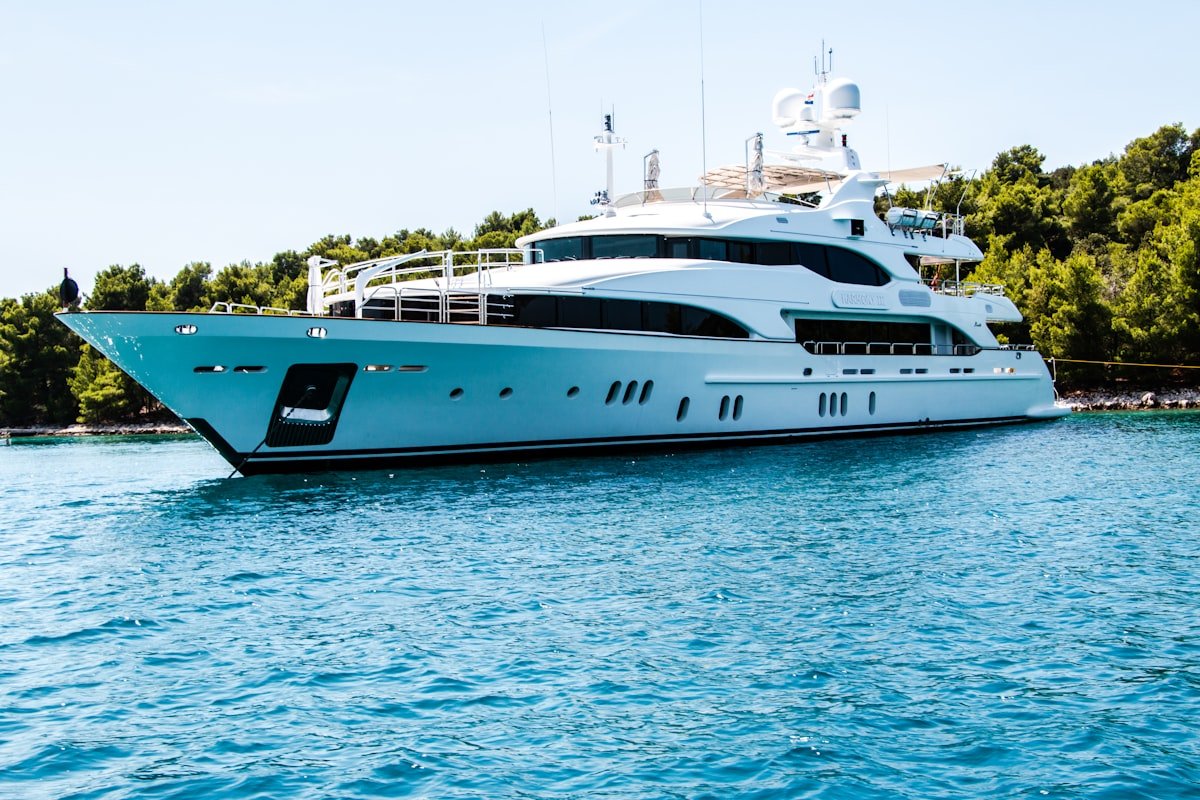
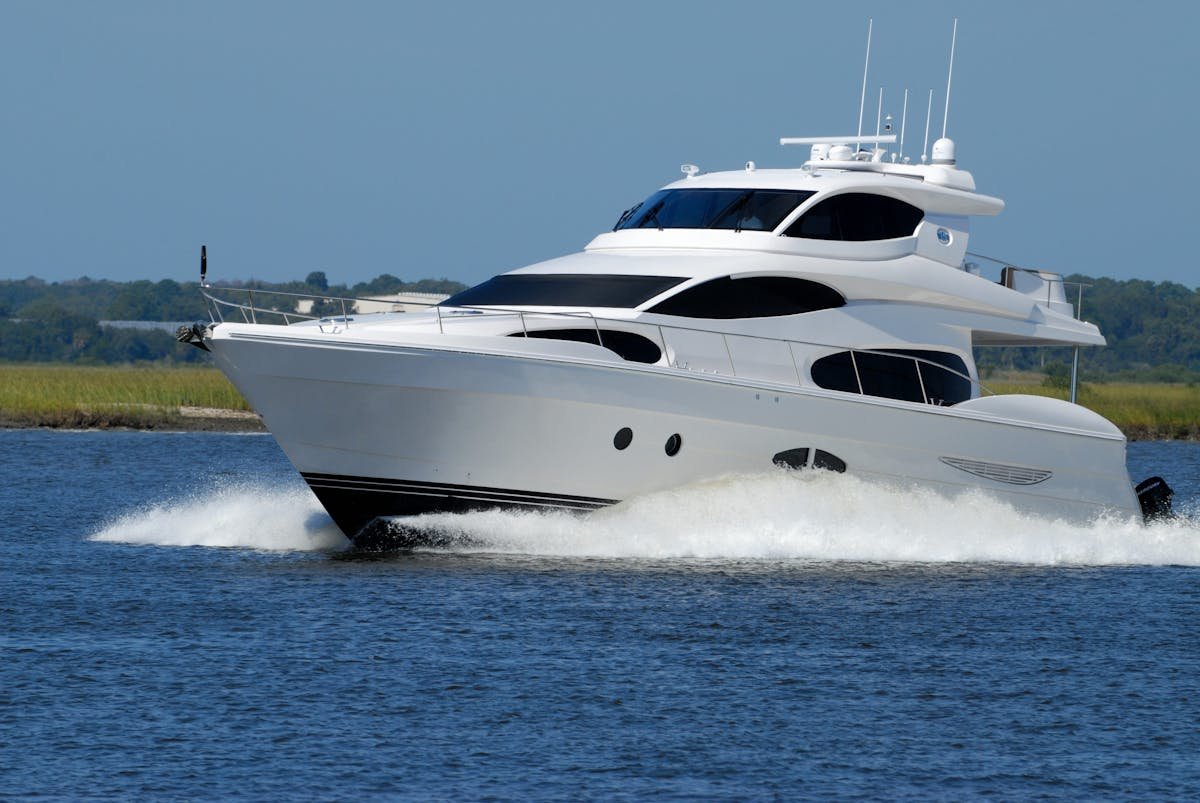
Crewed motor yachts in the 65-90ft range dominate the Caribbean superyacht market. Speed (15-25 knots) allows covering the Grenadines’ 65-mile chain in a single day instead of three. Full crew handles all navigation, cooking, and service. Stabilizers reduce motion at anchor in open bays exposed to swell.
Trade-offs for Caribbean motor yachts: Fuel consumption is substantially higher than in the Mediterranean due to longer inter-island passages. APA should be budgeted at 35-40% for a Caribbean motor yacht charter. St. Martin and Antigua’s marina infrastructure handles larger motor yachts well; smaller island harbors in the Grenadines may require anchoring off.
Sailing Monohull
Best for: Experienced sailors, couples, purists who enjoy active sailing.
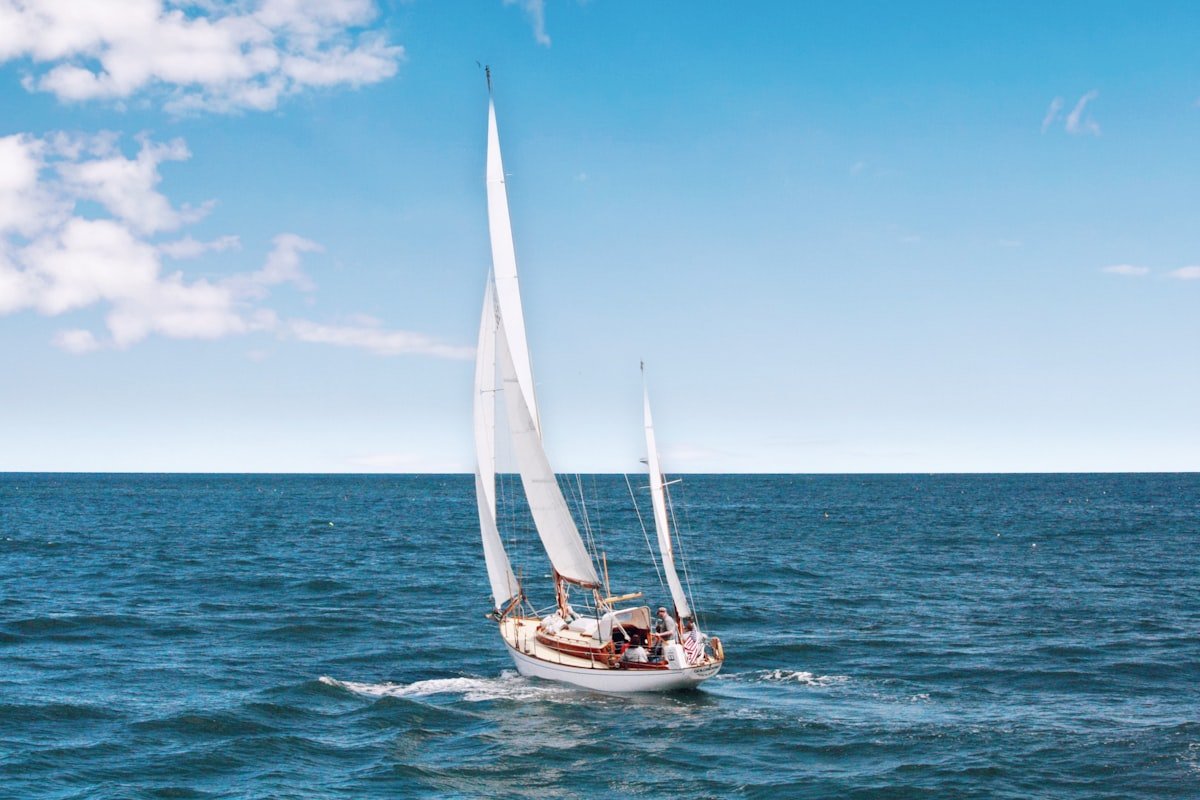
Monohulls cost 20-30% less than equivalent catamarans and offer a more responsive, performance-oriented sailing experience. The Caribbean’s consistent trade winds reward sailors who want to genuinely sail rather than motor from anchorage to anchorage. A 45-50ft bareboat monohull in the BVI costs $4,000-$10,000 per week.
Trade-offs: Less interior space than a catamaran, motion at anchor in open bays, and slightly more skill required. Not recommended for first-time charterers or those prone to motion sickness.
Planning Your Caribbean Charter
The booking process follows a consistent structure regardless of destination or yacht type.
Define Requirements First
Start with four questions: How many guests? What is the realistic all-in budget (base fee multiplied by 1.65)? Bareboat or crewed? Which islands and when?
Choose Brokers for Crewed Charters
For crewed charters above $15,000 per week, use a professional charter broker. Brokers access the full Caribbean fleet across all major operators, negotiate on your behalf, and handle contracts and insurance verification. Their commission (15-20% of charter fee) is paid by the yacht owner. Request proposals from two or three brokers and compare. New to the process? The basics of bareboat versus crewed, APA, and how to choose a broker are covered in detail in our complete yacht charter guide.
Book at the Right Time
Peak season (December-April) requires 6-9 months of lead time. Christmas-New Year week demands 10-12 months. Shoulder season (May-July) can be arranged 3-4 months out. If you are comparing the Caribbean with a Mediterranean charter, see our Mediterranean yacht charter guide for a direct seasonal and cost comparison.
Review the Contract Carefully
Caribbean charter contracts typically follow MYBA standards or individual operator formats. Key terms to verify: cancellation policy (typically 50% loss within 90 days, 100% within 30 days), APA percentage and reconciliation process, crew gratuity expectations, insurance coverage and deductible amounts, and the operator’s weather cancellation policy.
Good to know: Caribbean charter insurance deductibles commonly run $10,000-$50,000 depending on yacht value. Supplemental charter insurance covering the deductible costs $150-$400 for a week’s charter. It is almost always worth adding.
Costly Mistakes to Avoid
Based on analysis of broker feedback and 150+ post-charter reviews from Caribbean charter guests, these are the errors that cost the most money and enjoyment.
Budgeting only the base fee. The base fee is 50-60% of total cost. An $18,000 crewed catamaran charter becomes $28,000-$30,000 all-in after APA, crew tips, mooring fees, and provisioning extras. Multiply the listed fee by 1.65 before comparing budgets.
Avoiding June and July out of hurricane fear. If budget is a priority and flexibility exists, June and July offer the Caribbean’s best value: 20-30% lower rates, uncrowded anchorages, and manageable sailing conditions for the majority of the season. The real risk window is August-October.
Choosing motor yacht without checking fuel costs. A 75ft motor yacht doing the Grenadines’ 65-mile chain can burn $4,000-$8,000 in fuel in a single week. This comes from APA. Many first-time motor yacht charterers are surprised by how much of their APA disappears into the fuel tank.
Underestimating the Grenadines for first timers. The Grenadines are spectacular but not beginner-friendly for bareboat sailing. Open passages, stronger swells, and more demanding navigation make the BVI or Martinique a better starting point. The Grenadines reward a second or third Caribbean charter.
Ignoring mooring ball availability. The BVI’s National Parks Trust mooring balls at Norman Island, the Indians, and Pelican Island sell out by early afternoon in peak season. Arriving after 2 PM in January or February means anchoring in open water outside the park zone. Plan to be at popular anchorages before midday.
Skipping charter cancellation insurance. Cancelling a Caribbean charter within 30 days means losing 100% of the charter fee, potentially $15,000-$80,000+. Comprehensive charter insurance covering cancellation, medical evacuation, and personal liability costs $300-$600 for a week’s charter. It is essential, not optional.
The Noblexperience Verdict
Based on pricing data from 6 broker platforms and 150+ Caribbean charter reviews, verified March 2026.
Bottom line: The Caribbean offers the world’s most accessible yacht charter environment for first-timers (BVI), the most exclusive remote sailing (Grenadines), and the best European-quality provisioning at Caribbean prices (Martinique/Guadeloupe). The all-in cost is 1.6-1.7x the base fee, catamaran is the right choice for 70% of groups, and December through April delivers the most reliable conditions.
Choose your destination by profile:
- Best for first-timers: British Virgin Islands (short hops, excellent infrastructure, no serious navigation challenges)
- Best for experienced sailors: The Grenadines (remote, dramatic, Tobago Cays and Mustique access)
- Best value per dollar: Martinique and Guadeloupe (French provisioning quality at 20-30% lower prices)
- Best marina and regatta culture: Antigua (Falmouth Harbour, Sailing Week, Nelson’s Dockyard)
- Best multi-island hub: St. Martin (access to St. Barths, Anguilla, and Saba within a day’s sail)
Save money without compromising:
- Book May-July for 20-30% savings and empty anchorages (monitor forecasts during July)
- Choose Martinique or Antigua over BVI for equivalent quality at lower base rates
- Opt for a crewed catamaran over a motor yacht: similar crew service at 40-50% lower fuel costs
- Anchor in bays instead of marinas to save $100-$300 per night
- Book one-way (north to south with trade winds) in the Grenadines to eliminate counter-wind sailing
Protect your booking:
- Budget the all-in cost from the start: base fee x 1.65 minimum
- Buy supplemental charter insurance covering the deductible ($150-$400)
- Verify MYBA or operator contract terms before signing
- Avoid August-October bookings unless you have full flexibility and comprehensive coverage
Best for: Groups of 6-10 celebrating milestones, experienced Med charterers seeking a different sailing culture, families combining snorkeling and sailing in warm water, couples wanting a private floating villa with crew.
Not ideal for: Solo travelers or pairs (charter economics require 6+ guests for good per-person value), travelers seeking all-inclusive simplicity without the logistics of yacht life, anyone unable to commit to a fixed one-week window (weather and mooring availability require planning).